
Digital Impacts Schema and Taxonomy
Digital Impacts Schema and Taxonomy (DIST)
Standards-aligned guidance to categorise, structure and report your organisation’s digital technology sustainability data.
Sustainability reporting is hard & digital technologies are complex.
DIST is here to help.
✔ Open guidance
Publicly accessible resources stewarded by seasoned digital sustainability practioners to guide you through impact assessment and reporting best practices.
✔ Aligned to existing standards
A framework aligned with existing environmental reporting standards, with flexibility to adapt as future standards emerge.
✔ Holistic and beyond carbon
Covering digital's full supply chain and designed to extend beyond carbon towards emerging impact dimensions such as water, health, critical minerals.
What DIST offers.
An integrated suite of three open-source tools to support assessment and reporting of your organisation's digital technology environmental impacts.
Catch the important things
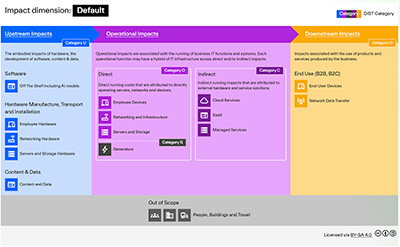
1. Taxonomy
Standardised categorisation system covering digital's full lifecycle and compatible across multiple impact dimensions - ensures nothing important is missed.
Measure with confidence
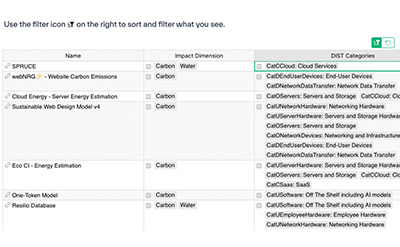
2. Methodologies map
Curated list of available measurement and estimation methods across all categories of the taxonomy - find approaches to fill the gaps in your numbers.
Share transparently
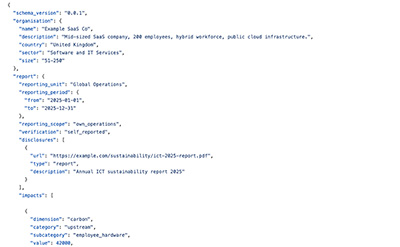
3. Schema
A structured data format for sharing your quantified tech impact numbers - creates transparency about your scope and measurement approaches.
DIST meets you where you are.
You can use all three parts of DIST's tooling suite to support your end to end reporting process, or pick and choose the parts that help meet your needs.
If you're new to digital sustainability and don't know where to start.
Most organisations start with using the taxonomy categories to map out the scope they want to report on. The approach is flexible meaning you can use it to understand things at just an application, product or service level - you don't have to start with your whole organisation's digital estate. You also don't have to attempt to get numbers for every single category, you can skip the parts that you're not ready for and make that clear in any final reporting you do using the schema.
You know the categories you want to report on, but aren't sure how to work out the numbers.
DIST's methodologies map is a carefully curated list of methods you can use to help you estimate figures for any part of the taxonomy.
You already do environmental impact reporting, but want to standardise how to present it.
The schema is there to help you with the final step of making your estimated figures standardised and transparent for others to see. You can use it to make your scope boundaries clear (what you did and didn't include), as well your confidence in your reported numbers.
Need help? Get support from the humans behind DIST.
DIST is open-source, community driven and stewarded by Green Web Foundation with the support of other digital sustainability professionals for public benefit.
If you need help with any aspect of DIST, reach out to us! We'll assess your needs in order to put you in contact with an appropriate group that can help you. Please bear in mind that Green Web Foundation is a non-profit organisation working with a limited budget in a difficult climate (yes, pun intended) - your patience is appreciated and we'll respond to you as quickly as humanly possible.